Image introduction of meditation Adjustable Chair MCH1-Grey
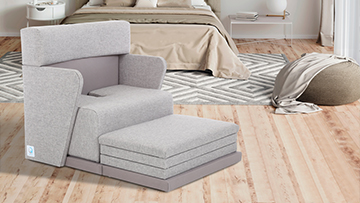
Image Introduction of Meditation Adjustable Chair MCH1 – Grey
A conversation between curiosity and calm.Why do meditators even need an adjustable chair?
That’s the first question most of us ask. Aren’t meditation and simplicity supposed to go hand in hand — just a cushion, a mat, maybe a candle?The answer, says Quelea’s design team, is that simplicity doesn’t mean discomfort. Modern meditators live longer hours in seated practice, often in apartments or studios where floors are hard and posture suffers. The Quelea MCH1 Adjustable Meditation Chair was created to bridge the gap between ancient stillness and modern ergonomics — giving the body enough support so the mind can actually let go.
“You don’t reach enlightenment by ignoring your knees,” laughs one teacher who has used the chair for two years.
What exactly is the MCH1 – Grey?
It’s Quelea’s signature adjustable meditation sofa-chair, hand-crafted in Taiwan. The Grey Edition brings a sophisticated neutrality — a tone chosen to mirror stillness itself. Think morning fog, mountain stone, cool balance.The chair’s low profile encourages a grounded posture; its backrest and seat contour follow the body’s natural curves. A dual-patent mechanism hidden inside the base allows users to raise or lower the sitting height so that different leg lengths, flexibility levels, or postures (half-lotus, Burmese, or simple cross-legged) all feel stable and pain-free.
From the side, its silhouette flows like a soft wave. From above, it resembles an open lotus — form following function.
How does the Grey version differ from other colors?
Color psychology plays quietly but powerfully in meditation spaces. Grey, in Quelea’s palette, represents equilibrium — not too bright, not too heavy. It absorbs distraction. In photography and real life, it pairs effortlessly with wood, linen, plants, and candlelight.Western meditators often prefer this tone because it fits modern interiors: urban lofts, minimalist studios, even office corners turned into mindful retreats. The grey fabric diffuses light gently, appearing silver in the morning and charcoal in the evening — a living metaphor for transition between day and night practice.
How does the chair actually support the body?
Inside the MCH1 is a layered system of high-density foam and air-flow channels. The seat’s slight forward incline tilts the pelvis so the spine stacks naturally; the lumbar curve stays supported instead of collapsing. Armrests rest low and open, inviting shoulders to drop and the chest to expand.The result is effortless alignment — something even long-time yogis struggle to maintain on traditional cushions. People often describe the first sit as a surprise: they expect a chair, but what they feel is suspension, like being quietly held by the air itself.
“It’s the first meditation seat that disappears,” writes one American user. “After five minutes, all I notice is my breath.”
Isn’t using a chair less authentic than sitting on the floor?
This is a common concern among Western practitioners. Authenticity, however, lies in awareness, not endurance. Buddhist and yogic texts never glorified pain; they taught balance — sthira sukham asanam, a posture both steady and comfortable.The MCH1 respects tradition by keeping the sitter close to the ground while offering the adjustability that ancient monks didn’t need but modern bodies do. In this way, it honors lineage and anatomy equally.
What materials are used, and are they sustainable?
Each MCH1 is hand-assembled in Taiwan by artisans trained in upholstery and ergonomics. The Grey cover uses a linen-blend performance fabric that breathes naturally, resists heat build-up, and can be removed for washing. The internal frame is lightweight steel reinforced with composite fiber — strong yet easy to move.Quelea’s commitment to sustainability runs deep: recyclable packaging, water-based dyes, and local production that reduces shipping impact. Every stitch reflects the same mindfulness preached on the cushion.
“Meditation is awareness in action,” the company states. “That includes how we make things.”
Who is this chair designed for?
For everyone who has ever ended a meditation session rubbing their ankles.The MCH1 works for beginners learning to sit cross-legged, long-time practitioners seeking longer stillness, or teachers leading day-long retreats. Its adjustability accommodates different body types and flexibility levels, making inclusive group practice possible.
Many Western yoga teachers now use it for breathwork instruction, trauma-informed mindfulness, or sound-healing sessions where clients need to relax without lying down. It bridges comfort and consciousness — modern mindfulness in physical form.
How does it feel to use it in daily life?
Picture this: you come home after work, roll out your mat, and lower yourself into the MCH1. The grey fabric is cool under your palms. You adjust the seat height a notch higher — your hips open, your knees find the ground, your spine lengthens. Within seconds the day’s tension begins to dissolve.The chair doesn’t demand silence; it invites it. Some users read or journal on it, others drink tea or listen to ambient music. Because of its balanced aesthetics, it easily doubles as an elegant lounge piece when not in meditation use — mindfulness that doesn’t hide in a corner.
What do Western meditators ask most often?
- “Will it fit in my apartment?”
Yes. Its footprint is smaller than most armchairs — roughly the width of a yoga mat. - “Can I adjust it for kneeling practice?”
Absolutely. Lower the seat and angle the pelvis forward; it supports seiza posture beautifully. - “Does it really make a difference?”
Most report being able to meditate twice as long without discomfort. The chair removes physical distractions, which is the first step toward deeper focus. - “Is the price worth it?”
Think of it as investing in a lifetime of posture. Like a quality instrument, it enhances performance and prevents injury.
What does it look like in a meditation space?
In imagery, the MCH1 – Grey often sits near a window where light falls softly across its curves. A small table with a candle, a plant, and perhaps a bowl of crystals completes the scene. The tone of the fabric harmonizes with both warm and cool palettes, making photographs — and reality — feel calm but alive.Its minimalist presence lets the practitioner be the focal point. Whether captured in natural daylight or under studio lamps, the chair’s matte texture conveys quiet sophistication — beauty without noise.
What kind of feedback has it received from teachers and users?
Meditation coaches in Los Angeles and London praise it for “bridging comfort and elegance.” A therapist in Chicago calls it “the missing piece between mindfulness and posture therapy.”Online reviewers frequently mention relief from numb legs, improved breathing, and a stronger desire to sit daily. One summed it up simply:
“It turns meditation from effort into invitation.”
Why the adjustable design matters for Western practitioners
Western lifestyles — long hours at desks, car commutes, tight hip flexors — make traditional floor sitting painful. Quelea’s adjustable system allows micro-corrections in height and angle so the body re-learns balance gradually. This approach aligns with modern somatic awareness: meeting the body where it is today, not where ancient ideals expect it to be.How does it compare to typical ergonomic chairs?
While office chairs focus on productivity, the MCH1 focuses on presence. It doesn’t roll, recline, or distract. Its low center of gravity fosters grounding rather than multitasking. Yet, ergonomically, it surpasses many premium office chairs in spinal alignment and pelvic support.The difference is philosophical: an ergonomic chair helps you work longer; the MCH1 helps you be longer.
Can design itself be meditative?
According to Quelea, yes. Every curve, seam, and angle of the MCH1 was refined through countless meditation trials by real practitioners. The designers meditated while sketching, ensuring each line carried intentional calm. The final product reflects that practice — quiet geometry shaped by awareness.When you look at it, you sense stillness. When you sit, you embody it.
Final Reflection — What does the MCH1 – Grey represent?
The Quelea MCH1 Adjustable Meditation Chair – Grey is not merely an object; it’s a philosophy of ease. It stands for the modern meditator’s truth: that peace and design can coexist, that beauty can serve function, and that the body deserves the same compassion we cultivate in the mind.It is where architecture meets awareness — a sculpted reminder that stillness need not be rigid, and comfort can be sacred.
Hand-crafted in Taiwan. Trusted by teachers worldwide. Chosen by those who believe mindfulness begins the moment you sit.
“When I settle into the MCH1,” one practitioner wrote,
“the world doesn’t disappear — it simply quiets.”
And sometimes, that’s all enlightenment needs.
QUELEA Meditation is the world's largest meditation product research and development center, offering a range of meditation-related products to help you create a personal sacred space. Please visit our homepage for more information.
QUSHOP Shop for Chair: https://www.qushop.net/v2/official/SalePageCategory/441482?sortMode=Curator&lang=en-US
QUSHOP Shop for Cushion: https://www.qushop.net/v2/official/SalePageCategory/441484?sortMode=Curator
Quelea Meditation Facebook page: https://www.facebook.com/queleameditation
Quelea Meditation YouTube channel: https://youtube.com/@quelea
Quelea Group: https://www.queleaglobal.com/tw/